
RAMAYANA – REDEFINES CINEMA! PK VERDICT: GOLD ⭐⭐⭐⭐
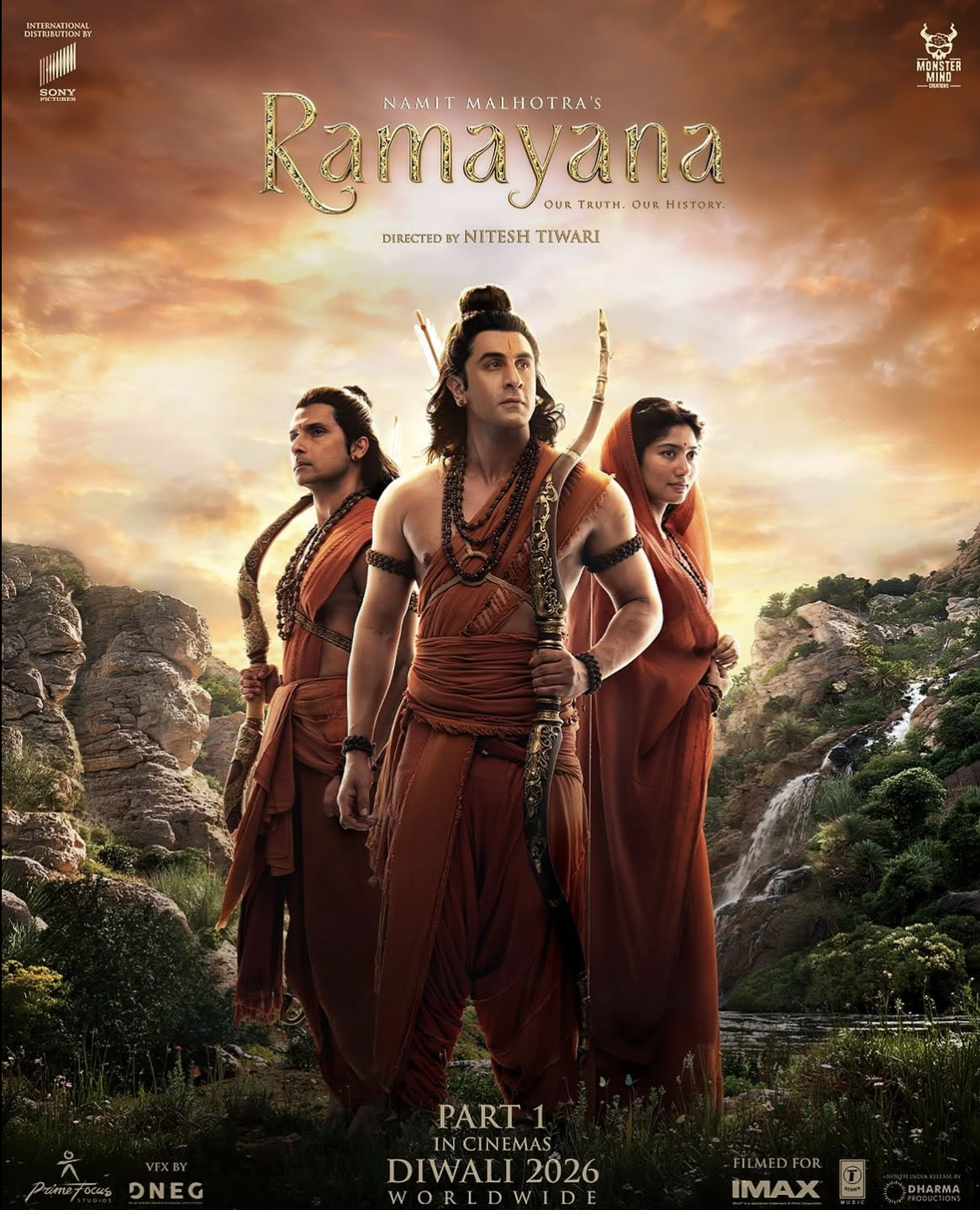
 Watch The Trailer
November 5, 2026
Ranbir Kapoor, Yash, Sai Pallavi, Ravi Dubey, Arun Govil
Theatre
Cultural , Event Cinema , History , Mythology
RAMAYANA – REDEFINES CINEMA!
An epic that gets the soul right, the spectacle bigger and the ticket pricing ??
Some films are made to entertain. Some are made to impress. And then there are films that attempt to redefine how Indian cinema dreams. Nitesh Tiwari’s Ramayana, backed by Namit Malhotra, belongs to the third category.
The biggest victory of Ramayana is that it understands one thing: an epic may need a universe-sized canvas, but it cannot afford to lose its soul. And thankfully, despite the staggering scale, the film never loses sight of the story or its characters.
Nitesh Tiwari’s direction is stellar, particularly in the simplicity with which he presents characters of such monumental significance. There is no unnecessary theatricality in the way the principal characters are portrayed. The performances stay rooted, the emotions remain accessible, and the grandeur never completely takes over the storytelling. That balance is no small achievement.
Ranbir Kapoor as Ram is a casting masterstroke. He brings a certain serenity, restraint and gravitas to the character that makes his portrayal convincing. The transition from playing a character as ferocious as Animal to embodying Lord Ram is a testament to his range. The duality is extraordinary.
And then comes a casting decision that deserves a special mention: Arun Govil as Dashrath. It is more than a nostalgic casting coup. It is a beautiful passing of the baton. The face that once became synonymous with Ram for an entire generation now returns as his father. Giving it a full circle, and the audience gets an emotional full-circle moment. A masterstroke!
Sai Pallavi as Sita is another inspired choice. Language becomes irrelevant when an actor can communicate through her eyes, and Sai does precisely that. Her expressions carry the emotional weight of the character without having to spell everything out. Ravi Dubey as Lakshman is equally impressive, while the supporting cast, including the actors portraying Suparnakha (Rakul Preet), Vidyut (Vivek Oberoi), Mareech(Saurabh Sachdeva), Mandodari (Kajal Aggarwal), Kaushalya, Kaikasi(Shobana), kaikeyi(Lara Dutta), Sage Vashishtha, make their presence count.
The Ayodhya portions are particularly effective. The family dynamics, the emotional undercurrents and the relationships that shape the epic are given their due. Lara Dutta and Sheeba Chaddha are brilliant, while Arun Govil becomes the emotional spine of this chapter.
And then there is Ravana!
The build-up to Yash’s introduction is quite a spectacle. The character development gives the entry its weight, and the anticipation pays off. The Tandav sequence is an absolute treat, although the narrative interruptions within the song slightly dilute its impact. One wishes the makers had allowed the sequence to flow uninterrupted. When the spectacle is this good, sometimes the best edit is to simply let it breathe!
The film also deserves credit for its visual storytelling. The familiar imagery of arrows facing each other evokes memories of Ramanand Sagar’s Ramayan, but the makers wisely resist overplaying nostalgia. It is a reminder of the legacy without becoming a tribute show. It was fun to see this coming.
Technically, Ramayana is a visual spectacle that commands your attention. The cinematography and production design are outstanding. The VFX, digital integration and sheer scale of execution are evident throughout. From the trio’s first chase by the Asuras to Ram creating a tornado through an arrow empowered by a mantra, and the spectacular Pushpak Viman versus Jatayu sequence, the film repeatedly demonstrates the ambition behind its making.
The background score is immersive, and the music is far better integrated into the narrative than the online trolling would have you believe. It complements the visuals rather than constantly competing with them. The dialogues carry gravitas, the editing remains sharp for the most part, and several sequences leave a lasting impression.
At 195 minutes, Ramayana demands your time, but it also gives you enough to remain invested. Barring the interval and a few minor hiccups, the film holds your attention remarkably well. The spectacle is so absorbing that blinking almost feels like missing out!
But is it worth the money being charged for it? That’s where the epic hits a rather unepic roadblock!
Let’s get one thing straight. Investing ₹4,000 crore in a film does not give anyone the right to make the audience pay through their nose to watch it. A production budget, however astronomical, is the filmmaker’s ambition and the producer’s business decision. It cannot automatically become the audience’s financial burden.
Yes, Ramayana deserves a big screen. Its visual grandeur is designed for the theatrical experience. But when ticket prices cross ₹500, the economics of a family outing become ridiculous. A family of four watching a prime-time weekend show, factoring in tickets, food and other expenses, can easily find itself staring at a bill approaching ₹15,000.
Now that’s an epic of an entirely different kind!
And the value-for-money equation becomes even more complicated because the film leaves you craving for more. But here’s the catch: everybody already knows the story. The cliffhanger is not exactly a mystery when the destination is part of our collective cultural memory. You aren’t wondering what happens next; you’re waiting to see how the makers bring it to life.
The film is clearly the beginning of a larger cinematic journey, with more instalments expected. Ranbir Kapoor has also spoken about the possibility of a third part. So, potentially, audiences are signing up for a multi-year cinematic commitment to a story they already know.
There is nothing wrong with that. In fact, the ambition to introduce India’s greatest epic to a global audience is commendable. The vision is visible, the mission is ambitious, and the execution largely delivers.
But the question remains: must the audience pay an epic price for an epic experience?
We’ve seen Sanjay Leela Bhansali create cinematic grandeur repeatedly. Spectacle is wonderful, but grandeur alone cannot be the final measure of cinematic success. The fruit cannot forever be expected to be bigger than the tree. Ultimately, the film must connect, sustain and justify the investment commercially as well.
Whether Ramayana recovers its staggering investment is a question for the box office. And we genuinely hope it does. Indian cinema deserves ambitious filmmaking, and projects of this scale deserve to succeed.
But as a cinephile, it pinches when the price of watching cinema begins to compete with the cost of living!
PK VERDICT: GOLD ⭐⭐⭐⭐
P.S. The first ever glimpse revealed for Ramayana is yet to see the light of the day – Ram Vs Ravana!!!